Approximation Theory and Method ch7
… as the sign of $p(x)$. It follows that $p^{\ast}$ is a best minimax approximation from $\mathscr{A}$ to $f$ if there is no function $p$ in $\mathscr{A}$ that satisfies the condition \(\left[f(x)-p^{\ast}(x)\right] p(x)>0, \quad x \in \mathscr{Z}_{\mathrm{M}}\quad \text {. (7.6) }\)
Because of the way in which the exchange algorithm works, we generalize the problem of minimizing $\lVert f-p \rVert_{\infty}$, to the problem of minimizing the expression
\[\max _{x \in \mathscr{X}}\lvert f(x)-p(x) \rvert, \quad p \in \mathscr{A}\quad \text{(7.7)}\]where $\mathscr{Z}$ is any closed subset of $[a, b]$, which may be $[a, b]$ itself, but in the exchange algorithm the set $\mathscr{Z}$ is composed of a finite number of points. The next theorem allows $\mathscr{Z}$ to be general.
Theorem 7.1 Let \( \mathscr{A} \) be a linear subspace of \( \mathscr{C}[a, b] \), let \( f \) be any function in \( \mathscr{C}[a, b] \), let \( \mathscr{Z} \) be any closed subset of \([a, b]\), let \( p^{\ast} \) be any element of \( \mathscr{A} \), and let \( \mathscr{Z}_{\mathrm{M}} \) be the set of points of \( \mathscr{Z} \) at which the error \( \left\lbrace\left\lvert f(x)-p^{\ast}(x)\right\rvert ; x \in \mathscr{Z}\right\rbrace \) takes its maximum value. Then \( p^{\ast} \) is an element of \( \mathscr{A} \) that minimizes expression (7.7) if and only if there is no function \( p \) in \( \mathscr{A} \) that satisfies condition (7.6).
不严谨说,如果能找到一个 $p(x) \in \mathscr A$, 使得 $p(x)$ 和 $f(x)-p^{\ast}(x)$ 符号一样,那么这个 $p(x)$ 肯定可以让 $\lVert f-p \rVert_{\infty}$ 更小——通过找一个比较合适的 $\theta$,这个 $\theta$ 要足够小——小到在每一个点 $x \in \mathscr Z_M$ 处都不会减爆. 因为可以任意小,所以这样的 $\theta$ 肯定存在.
Haar Condition
(1) If an element of $\mathscr{P}_{n}$ has more than $n$ zeros, then it is identically zero.
大概就是说,最高次数是 $n$ 的多项式最多有 $n$ 个零点——
或者有无穷多个零点,处处都是 $0$.
(2) Let $\left\lbrace\zeta_{j} ; j=1,2, \ldots, k\right\rbrace$ be any set of distinct points in the open interval $(a, b)$, where $k \leqslant n$. There exists an element of $\mathscr{P}_{n}$ that changes sign at these points, and that has no other zeros. Moreover, there is a function in $\mathscr{P}_{n}$ that has no zeros in $[a, b]$. The following two properties of polynomials are required later:给出了多项式的存在性,任意给定一些点,肯定有一个多项式在这些地方变号,只要变号的次数小于等于 $n$.
(3) If a function in $\mathscr{P}_{n}$, that is not identically zero, has $j$ zeros, and if $k$ of these zeros are interior points of $[a, b]$ at which the function does not change sign, then the number $(j+k)$ is not greater than $n$. \(p(x) = \prod (x - x_i)^{n_i}\)
不变号的零点肯定是多项式里某些要素是偶数次方,所以至少贡献两个 degree.
(4) Let $\left\lbrace\xi_{j} ; j=0,1, \ldots, n\right\rbrace$ be any set of distinct points in $[a, b]$, and let $\left\lbrace\phi_{i} ; i=0,1, \ldots, n\right\rbrace$ be any basis of $\mathscr{P}_{n}$. Then the $(n+1) \times$ $(n+1)$ matrix whose elements have the values $\left\lbrace\phi_{i}\left(\xi_{j}\right)\right.$; $i=0,1, \ldots, n ; j=0,1, \ldots, n\rbrace$ is non-singular.大概就是任意一些不一样的点换基换到多项式空间,都是不会丢失维数的. (?) 忘了x
Haar Condition 就是多项式空间满足的一些性质,在下面有关的证明里面实际上我们只用到多项式的一部分性质,有这些性质就够用了. 于是可以做一些拓展,把这些一部分的性质拿出来,毕竟我们只要用这么多东西,那其他满足这些东西的线性空间也是适用的.
An $(n+1)$-dimensional linear subspace $\mathscr{A}$ of $\mathscr{C}[a, b]$ is said to satisfy the ‘Haar condition’ if these four statements remain true when $\mathscr{P}_{n}$ is replaced by the set $\mathscr{A}$. Equivalently, any basis of $\mathscr{A}$ is called a ‘Chebyshev set’.
It is proved that properties $(1),(3)$ and (4) are equivalent, and that these properties imply condition (2).
这里相关的证明,一般就看 $(1)$ 就行了.
Theorem 7.2 (Characterization Theorem)
Let $\mathscr{A}$ be an $(n+1)$-dimensional linear subspace of $\mathscr{C}[a, b]$ that satisfies the Haar condition, and let $f$ be any function in $\mathscr{C}[a, b]$. Then $p^{\ast}$ is the best minimax approximation from $\mathscr{A}$ to $f$, if and only if there exist $(n+2)$ points $\left\lbrace\xi_{i}^{*} ; i=0,1, \ldots, n+1\right\rbrace$, such that the conditions
\[\begin{aligned} & a \leqslant \xi_{0}^{*}<\xi_{1}^{*}<\ldots<\xi_{n+1}^{*} \leqslant b, \\ & \left\lvert f\left(\xi_{i}^{*}\right)-p^{\ast}\left(\xi_{i}^{*}\right)\right\rvert=\left\lVert f-p^{\ast}\right\rVert_{\infty}, \quad i=0,1, \ldots, n+1, \end{aligned}\]and
\[f\left(\xi_{i+1}^{*}\right)-p^{\ast}\left(\xi_{i+1}^{*}\right)=-\left[f\left(\xi_{i}^{*}\right)-p^{\ast}\left(\xi_{i}^{*}\right)\right], \quad i=0,1, \ldots, n,\]are obtained.
只要不存在 $p$ 使得 $\left[f(x)-p^{\ast}(x)\right] p(x)>0$ 那么就有最优.
嘛……大概说说自己的思路,不一定对. 姑且把 $\mathscr{A}$ 当成 $\mathscr P_n$ 来想,因为 $p(x)$ 在他所在的空间 $\mathscr P_n$ 里面,只要是有 $n$ 个零点的东西都能找到一个 $p(x)$ 使得他们零点构成一样——所以就要 $\left[f(x)-p^{\ast}(x)\right]$ 有更多的零点,至少要 $n+1$ 个. 想要 $n+1$ 个零点,那这个连续函数至少要 $n +2$ 个交替分布在横轴上下的一些点,也就是这里说的 $\left\lbrace\xi_{i}^{*} ; i=0,1, \ldots, n+1\right\rbrace$.
但是,$\mathscr C [a,b]$ 实际上是 piecewise continuous, 而且 $\mathscr{A}$ 也不是 $\mathscr P_n$ , $\left[f(x)-p^{\ast}(x)\right]$ 不一定连续, 不能用那个什么所谓的零点存在性定理.
直接用 Haar Condition 的(2)——因为 $p(x)$ 满足Haar condition,所以 $p(x)$ 变号了 $n$ 次,也就是存在 $n+1$ 个符号相间的值, 我们希望 $\left[f(x)-p^{\ast}(x)\right]$ 的编号次数更多,至少是 $n+1$ 次,也就是至少存在 $n+2$ 个符号相间的值.
回忆一下切比雪夫多项式: \(T_{n}(x)=\cos (n \theta), \quad x=\cos \theta, \quad 0 \leqslant \theta \leqslant \pi .\) 也就是 $T_n(x) = \cos (n \arccos x)$. $n$ 越大上下震荡的次数越多.
$n = 1$:
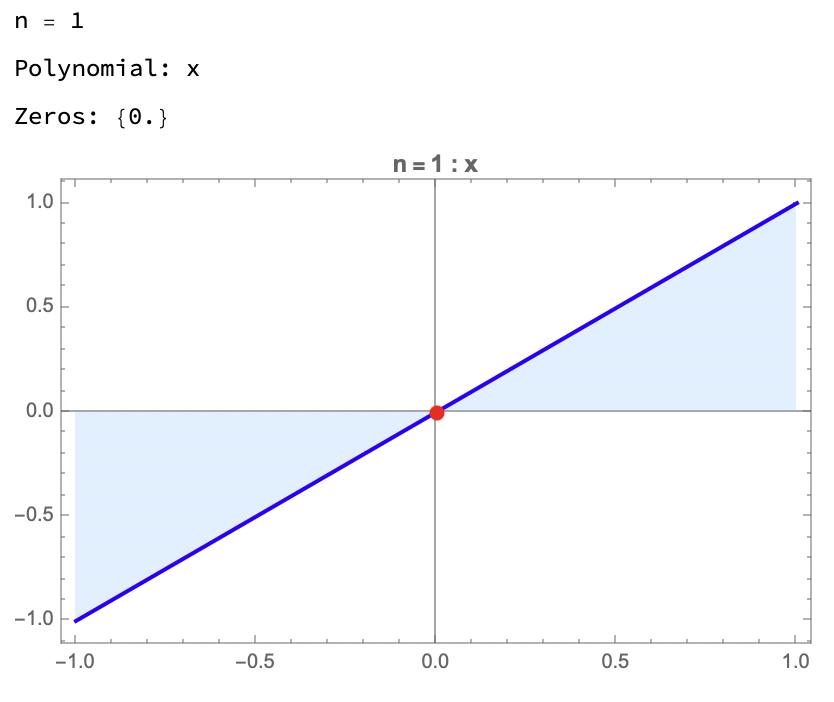
零点:
\[\lbrace\lbrace x\to 0\rbrace\rbrace\]$n = 2$:
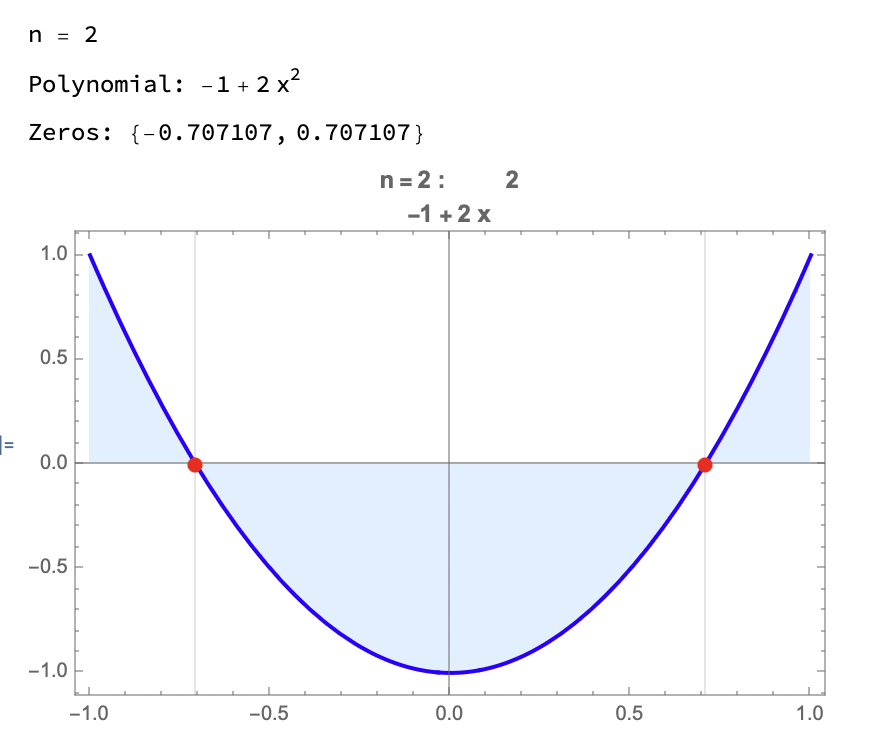
零点: \(\left\lbrace\left\lbrace x\to -\frac{1}{\sqrt{2}}\right\rbrace,\left\lbrace x\to \frac{1}{\sqrt{2}}\right\rbrace\right\rbrace\) $n = 3$:
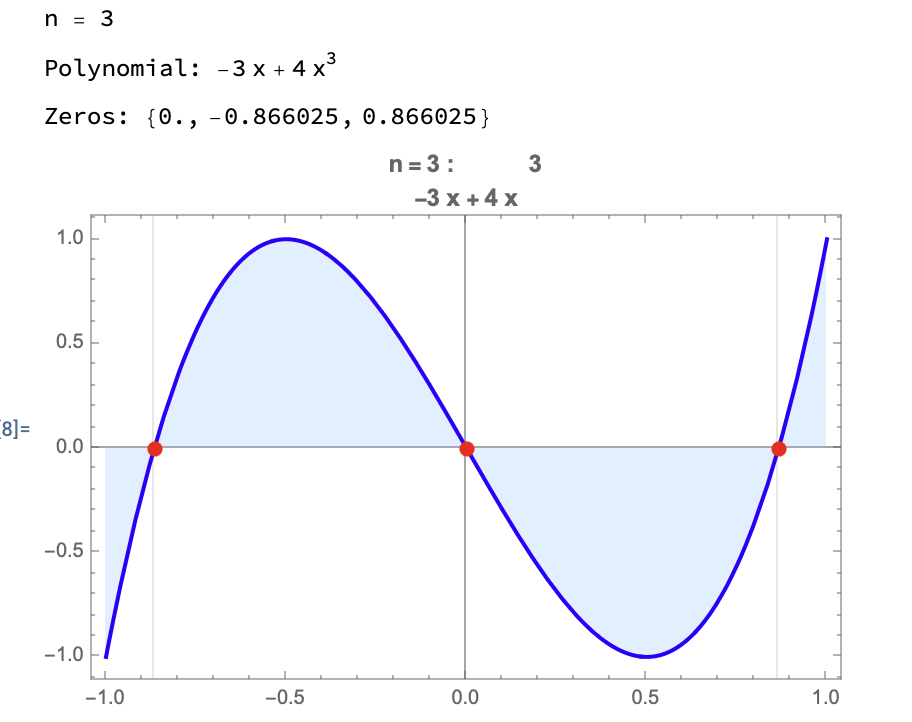 \(\left\lbrace\lbrace x\to 0\rbrace,\left\lbrace x\to -\frac{\sqrt{3}}{2}\right\rbrace,\left\lbrace x\to \frac{\sqrt{3}}{2}\right\rbrace\right\rbrace\)
$n = 6$ :
\(\left\lbrace\lbrace x\to 0\rbrace,\left\lbrace x\to -\frac{\sqrt{3}}{2}\right\rbrace,\left\lbrace x\to \frac{\sqrt{3}}{2}\right\rbrace\right\rbrace\)
$n = 6$ :
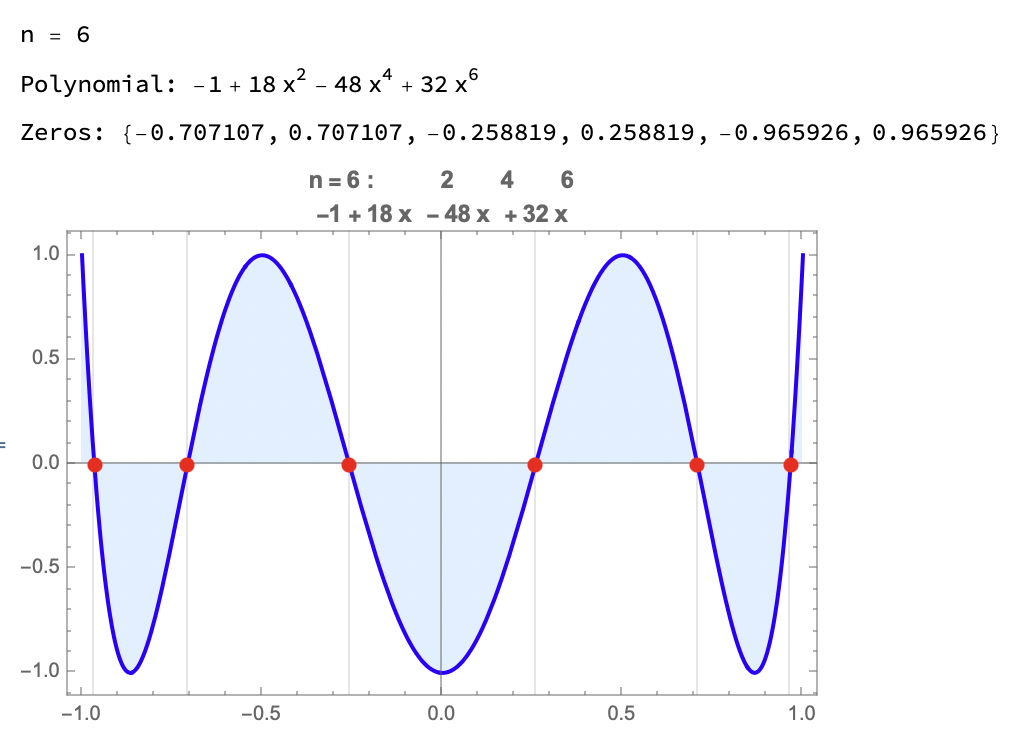
递推关系:
因为$T_0(x) = 1, T_1(x) = x$, 结合递推关系, 我们可以知道 $T_n$ 的最高次数是 $n$, 并且最高次项的系数是 $2^{n -1}$.
Theorem 7.3
Let the range of $x$ be $[-1,1]$, and let $n$ be any positive integer. The polynomial $\left(\frac{1}{2}\right)^{n-1} T_{n}$ is the member of $\mathscr{P}_{n}$, whose $\infty$-norm is least, subject to the condition that the coefficient of $x^{n}$ is equal to one. 因为切比雪夫多项式交替取到最大最小值, 根据 Theorem 7.2 (Characterization Theorem) 我们可以知道在 $\mathscr{P}_{n}$ 中 $\left(\frac{1}{2}\right)^{n-1} T_{n}$ 是 inf-norm 最小的多项式.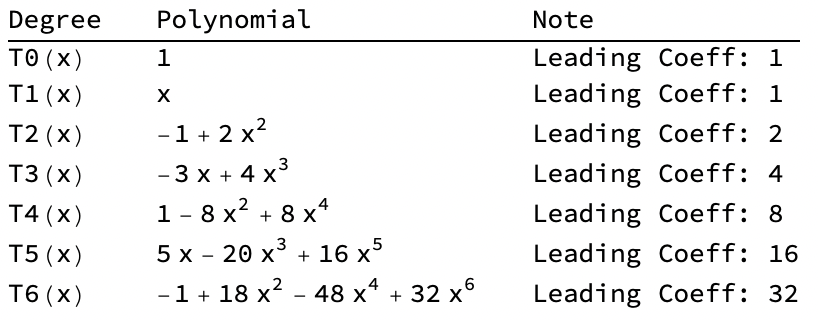
Theorem 7.7 Let the conditions of Theorem 7.2 hold, let \( p^{\ast} \) be any element of $\mathscr{A}$, and let $\left\lbrace\xi_i ; i=0,1, \ldots, n+1\right\rbrace$ be a reference, such that the condition
is satisfied. Then the inequalities
are obtained. Moreover, the first inequality is strict unless all the numbers $\left\lbrace\left\lvert f\left(\xi_i\right)-p^*\left(\xi_i\right)\right\rvert ; i=0,1, \ldots, n+1\right\rbrace$ are equal.
这个定理为后面的 exchange algorithm 做了铺垫——确定了一些上下界.
最后一个 $\leqslant$: 最优时的 $p$ 肯定距离 $f$ 最近;
倒数第二个 $\leqslant$: 在一些子集处的最大肯定比全局最大要小; 也就是无论怎样更换 reference 也不会导致比最优大——实际上我们在 exchange algorithm 中就是不断更换 reference 使得 $\left\lvert f\left(\xi_i\right)-p\left(\xi_i\right)\right\rvert$ 尽量大, 会越来约靠近最优值, 也就是 $\min _{p \in \mathscr{A}}\lVert f-p \rVert_{\infty}$.
第一个 $\leqslant$: …